
The Antivenom

“Kindness is the antivenom.” — Anne Lamott
“My true religion is kindness.” — His Holiness the Dalai Lama

I love playing the New York Times Spelling Bee game. One is given a “honeycomb” of seven letters with which to form as many words as possible within certain parameters. Every word has to contain at least four letters, and every word must include the center letter in the honeycomb. You get points for every word, depending on its length. Every “Bee” has at least one word that contains all seven letters — a so-called “pangram” — and you get extra points for finding that word. For example, in the “Bee” shown below, the pangram is “confirm.” Other possible words include “cirri,” croci,” “conform,” “foci,” “icon,” and “moronic,” with a total of 34 words in this particular game.
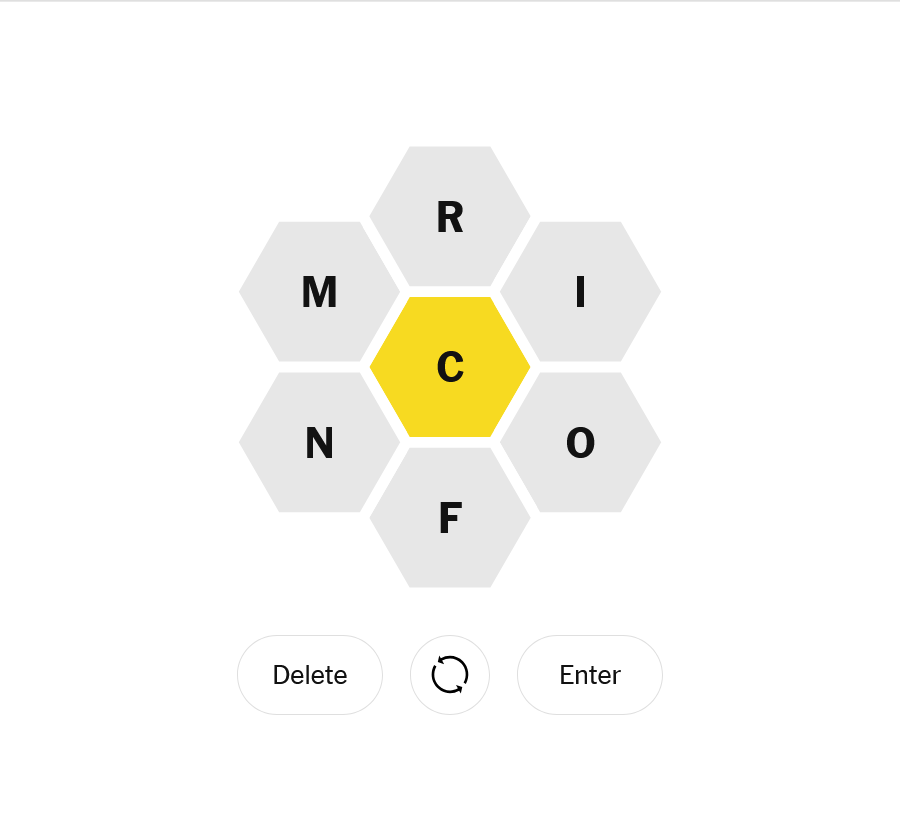
As you accumulate points, Spelling Bee announces your changing status: Beginner, Good Start, Moving Up, Good, Solid, Nice, Great, Amazing, Genius, and Queen Bee. Usually, I make it to Genius level and occasionally to Queen Bee, often with assistance from my husband, who also loves the game and usually plays it with me. Together, both of us aim for a high score, but we accept those days when we just don’t make it.
Neither of us can abide one of the rankings: “Nice.” When we reach that stage, both of us scurry to find more words so that we can leave “Nice” behind.
I dislike the word, “nice” — at least all by itself. Little girls are admonished to “be nice” in ways that little boys, in my experience, are not. Here’s what being nice means to me: being pleasant, well-mannered, and cheerful. Being nice is a matter of comportment, it seems to me, with nothing more than shallow expectations to back it up. Being nice can require swallowing your inner thoughts, regrets, worries and anger and pasting a smile on your face, no matter what, so that others will feel at ease (even if you don’t). It is performative, in other words. Cheerfulness and good manners are fine qualities, of course, but it seems to me that expecting people to hold their own discomforts at bay while they smooth the way for others is damaging for all concerned.
Generally speaking, I am pleasant and well-mannered myself, and I do try hard to make others welcome and comfortable. So, yes, I am nice. Most of the time anyway. But not at my own expense. I don’t aim to be nice in such a way as to ignore or abandon my deepest self. Being nice, all by itself, is not enough, because one can be nice without really making meaningful connections to others.
I do aim to be kind. “Nice” and “kind” are sometimes viewed as synonymous words, but being nice and being kind are not the same thing, as far as I am concerned. Being nice is more superficial — having good manners. Being kind runs deeper and is rooted in compassion. Being kind strikes me as being more active — and, to me, more honest because there is no expectation that I abandon myself to be kind to others. It means to be generous and helpful to others, to reach out with genuine concern, to take in the reality of the other and to respond from the heart. Rather than simply pasting a smile of my face, kindness requires me to dip into my stores of compassion and try to understand and help another.
In many circumstances, being nice and being kind go together. That’s a happy thing when it happens, but it isn’t always possible. For example, organizing an intervention for a loved one who is struggling with addiction would be a kindness, but, in all likelihood, the recipient of the intervention would not experience the intervention as “nice.”
My mother had a lot of sayings, some of them humorous, and most of them conveying homespun wisdom.
“A mule has two legs behind,” she would say, just for fun, “and two he has before. You stand behind before you find what the two behind be for.”
If I had a really bad day, she would remind me that “tomorrow is another day.” And if things seemed complicated, murky, and beyond comprehension, she would reassure me that, “It will all come out in the wash.”
I don’t know quite where she collected all those sayings, but she had quite a store of them and the ability to call them forth when necessary. One that captured my attention most vividly was this one:
“There is so much bad in the best of us and so much good in the worst of us that it little behooves any of us to talk about the rest of us.”
The first time she hauled out that saying for me, she probably had to define “behoove,” because I was pretty little. Maybe my fascination with that mysterious word was the first inclination that I would grow up to love words (which is to say I have the annoying habit of splitting hairs between words like “nice” and “kind”).
I like words. And even though I often forget their definitions after I look them up, it doesn’t matter. I just like words. For instance, the first time I encountered the word, “chthonic,” I thought, “Woah! Who puts a ‘ch’ right in front of a ‘th’?” (The Greeks, that’s who.) (Merriam Webster defines “chthonic” as “of or relating to the underworld; infernal.”)
But going back to the expression, “there’s so much bad in the best of us and so much good in the worst of us that it little behooves any of us to talk about the rest of us,” I think that was one of my earliest lessons about kindness, because it taught me something important about the fallibility of people — all people, including me. For me, kindness is inextricably linked to recognizing that we are all in this together — imperfect as we all are, flawed as we all are — and that, regardless of our shortcomings, we have hearts and hands that can reach out to one another. As one of my friends says, “We’re all Bozos on the bus.” With that understanding comes the imperative to make space for one another.
My mother was a kind person. She had her sharp edges, of course. No one is perfect, so why would she be? But people quickly discovered her kind core, and they flocked to her like bees to a flower. So, so many people turned to her for a listening, understanding, and accepting ear as a result of her kindness. She died 30 years ago. (I can’t believe that, but it’s true.) The anniversary of her death is approaching, and I find myself wondering what she would make of our unkind world today. Our world of blistering tweets and “truths” — replete with words that castigate and disparage others. Our world where it is perfectly okay to paint groups of people with a bitter brush of tarnish. Our world where people attack one another, rather than trying to listen and understand. Our world where the truth gets sacrificed in favor of some potent, shocking, and compelling lie. Our world where we seem so easily to forget “there is so much good in the worst of us and so much bad in the best of us.” My mother would abhor such brutality. I think she would agree with Anne Lamott that “kindness is the antivenom.”
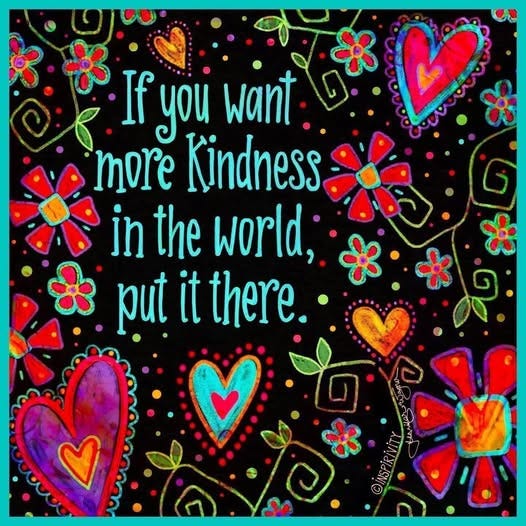
I confess, some days I find it hard to find my kind inner self. The world’s cruelty sometimes sets the bar too high for me. But I try to bear in mind that true kindness emerges from the deepest part of the soul. Accessing what compassion I can muster, I try to understand that all of us will suffer at some point — all of us, including ourselves. From that angle, I can muster some compassion and kindness for others.
Poet Naomi Shihab Nye’s poem, “Kindness,” makes a beautiful connection between kindness and suffering and sorrow.
Kindness, by Naomi Shihab Nye
Before you know what kindness really is
you must lose things,
feel the future dissolve in a moment
like salt in a weakened broth.
What you held in your hand,
what you counted and carefully saved,
all this must go so you know
how desolate the landscape can be
between the regions of kindness.
How you ride and ride
thinking the bus will never stop,
the passengers eating maize and chicken
will stare out the window forever.Before you learn the tender gravity of kindness
you must travel where the Indian in a white poncho
lies dead by the side of the road.
You must see how this could be you,
how he too was someone
who journeyed through the night with plans
and the simple breath that kept him alive.Before you know kindness as the deepest thing inside,
you must know sorrow as the other deepest thing.
You must wake up with sorrow.
You must speak to it till your voice
catches the thread of all sorrows
and you see the size of the cloth.
Then it is only kindness that makes sense anymore,
only kindness that ties your shoes
and sends you out into the day to gaze at bread,
only kindness that raises its head
from the crowd of the world to say
It is I you have been looking for,
and then goes with you everywhere
like a shadow or a friend.
Making that connection between kindness and suffering, one might then feel inspired to pour more kindness into the world. One might want to inoculate others with the kindness antivenom. One might want to try to mitigate the harm that cruelty and tragedy inflict on others.
Several years ago, I heard someone tell a wonderful wisdom story that, to me, exemplifies just how the kindness antivenom works. I don’t know the source of the story. (If you do know the source, perhaps you could let me know in the comments to this post.) The story goes like this:
Once a great battle between two armies raged. All day long the soldiers fought, and the casualties were epic, horrific, and tragic on both sides. At the end of the day, just two soldiers remained — one from each side. They looked at each other, exhausted and suffering the deep loss of their friends and companions. One said to the other, “Look, we are both so tired. Why don’t we just get a good night’s rest, and we can resume this battle in the morning.”
So, that’s what they did. But, before they laid down on the ground to sleep, they made a fire and pooled whatever provisions they had so that they could eat together. As they ate, they told each other about their homes and families. They showed each other the special talismans their loved ones had given them to carry with them into battle. They shared stories about their childhoods. They talked about the dreams they had for their children’s futures. Eventually the flames of the fire burned low, and the two soldiers bedded down and slept.
As the sun rose in the morning, they stirred into wakefulness. They looked at each other, and remembering all they had shared the night before, they realized they could no longer fight each other. So they simply sheathed their swords and turned and headed home.
Friends, it seems to me that great cultural and political battles are raging now. People have released a lot of venom into our world. What would it take for us to sheath our swords and head home? What would it take to administer the anti-venom we so badly need? The answers to those questions are surely complicated and probably beyond my powers to grasp in their entirety. But it seems to me, that at least part of the solution is to find our ways to reach out to one another in compassion and share with open heartedness. At least part of the solution — and, to my mind, a large part of the solution — dwells in the land of kindness. A large part of it is to ‘catch the thread of sorrow,’ ‘see the size of the cloth,’ and to weave the threads of compassion into that cloth.
There’s an old Yiddish expression: “The highest wisdom is kindness.” We can be wise, can’t we? So let’s trim hoist our sails and head for that.
Love,
Sylvia
Beautifully expressed! We need so much more kindness (antivenom) to counteract where we are today. Thank you for continuing to ‘beat the drum’ of hope to help us through these dark times.
Recently my cousins had their beloved dog die.
They’re a married couple with no children, and a twist of fate brought this wee dog into their lives. They both wove their daily caring into the life of sweet Kismet, and she threaded tightly into their days over 14 years.
And now their loss is so vast, their grief seems endless.
In responding to their suffering, I found myself writing about the gift of such a deep loss: compassion for the suffering of others.
In reading your Antivenom I realize the next thread is in the act of kindness, as you describe.
It’s how any of us get beyond “nice.”
The Ironic Gift of suffering.
And if we don’t find a way to make the suffering active, it can break the thread and cause us to “tie ourselves in knots.”
Grumpy.
Victim.
Revengeful.
Full of the venom of loss…
Huge thoughts to gain from your gift, Sylvie. Thank you…again.