
Persevering


For Those Whose Work Is Invisible, Mary Gordon
For those who paint the undersides of boats
Makers of ornamental drains on roofs too high to be seen
For cobblers who labor over inner soles
Seamstresses who stitch the wrong sides of linings
For scholars whose research leads to no obvious discovery
For dentists who polish each gold surface of the fillings of upper molars
For sewer engineers and those who repair water mains
For electricians
For artists who suppress what does injustice to their visions
For surgeons whose sutures are things of beauty
For all those whose work is for Your eye only
Who labor for Your entertainment or their own
Who sleep in peace or do not sleep in peace
Knowing that their effects are unknown
Protect them from downheartedness
And diseases of the eye
Grant them perseverance
For the sake of Your love
Which is humble, invisible
And heedless of reward.
My book group recently read The Tea Girl of Hummingbird Lane, by Lisa See. Other than recommending the book to you because it is good, I won’t discuss its plot or message. Except for this one thing: A major thread line through the novel involves a plot of land, the ownership of which travels through the generations from mother to daughter. Matrilineage.
That one part of the novel stirred unexpected feelings of sadness for me, because in my family I am the last in a line of mothers stretching all the way back through the generations to the first mother on the African savannah thousands and thousands of generations ago. Mother to daughter, mother to daughter, until me. My mother was an only child. I was her only daughter. I had no daughters, so that particular line of mothers ends with me.
Ultimately, that doesn’t matter. Plenty of other mothers and daughters are passing along matrilineage lines all across the globe. I’m pretty sure my singular line won’t be missed. Nonetheless, sadness falls upon me when I think about it. All those mothers bringing daughters forth. Feeding, nurturing, teaching, caring, guiding. Some lived to see their daughters grow and thrive. Some died well before that happened. Some probably even died in the very act of bringing their daughters to birth.
Some of them were wonderful mothers, some undoubtedly terrible. All were imperfect; all were human, their lives made up of joys and sorrows, successes and failures, frightening situations and safe harbors, wisdom and misguided thinking. Whatever the circumstances of their lives, life persevered through them. But, when I die, that line of mothers dies with me.
Facing that reality got me pondering lineages in general. It got me thinking about what we pass along to the next people, how we do it, and if we even know when something we’ve done or said has made any impact on another’s life. And that led me to Mary Gordon’s prayer, “For Those Whose Work is Invisible.” I love that prayer — the images it stirs and also the recognition that so often the things people say and do go unnoticed. When you come right down to it, for most of us, our work is invisible. Even for those whose work seems to be front and center — visible, in other words —sometimes it’s unclear at the outset how that work will travel into the world or what impact it will have. And yet we persevere.
The first time I heard Mary Gordon’s prayer was at my ordination. I had asked my colleague, the Rev. John Gibbons, to offer what we call the “Right Hand of Fellowship,” a ritual with Biblical origins tracing back to Paul (Galatians 2:9). As the story goes (and as John reminded us that day), church pillars offered Paul and Barnabas the right hand of fellowship because Paul and Barnabas appeared to be filled with grace. The idea was to divvy up the work of proselytizing: Paul and Barnabas were meant to help bring the faith far and wide. Through the centuries since then, clergy have extended their hands in welcome to the generations of clergy who followed them. A lineage, in other words. A pastoral lineage stretching way, way back.
For me, the ritual was imbued with a recognition that I was standing on the shoulders of so, so many people — not just clergy who had served through the vast expanse of time before my arrival on the scene, and not just the fellow clergy I had known in my lifetime up until that point — but also those people who had loved, taught, challenged, and nurtured me all along the way. Most of them were not clergy. The work of nearly all of them was invisible to the people at my ordination. I longed for my parents, for example, both of whom had died by then and neither of whom had been a minister. My mother died a couple of years before I entered seminary; my father died in the middle of my training.
On my heart, too, were many ministers and parishioners, past and present, whose example had helped to guide me to my truest self. Friends through the years. Teachers of all subjects. Classmates. Roommates. Neighbors. Colleagues from former work settings. Even chance encounters with people whose influence on me can never be recognized. The cumulative actions and words of an incalculable number of people helped to make me the person I was at the time of my ordination. The list of people who have influenced me has only continued to grow, of course. More people than I can name. More than I can remember. When I die, I will have collected a veritable throng of people who have helped me to learn and grow every step of the way. Their work was and is invisible, hard to pin down, difficult to name.
So it is for all of us. We are the recipients of the words and deeds of others. We are the products not just of genes, but of circumstances, social locations, relationships, and events beyond our control. We benefit from the work of engineers who repair water mains. And those who repair and paint the undersides of boats help to keep our boats from sinking. We may never know who those people are, but they hold us in their circle of care, nonetheless.
At my ordination, Rev. John Gibbons said, “I do not believe our ministry is some sort of chain letter which promises riches, billions and billions of blessings, so long as you do not break the chain. I do believe, nonetheless, that we are, in the words of . . . David Rhys Williams, ‘the indispensable link between the work that was and the world that is to be, comrades in the quest for the high places of life.’ Whether or not our lives and our world are enlarged or diminished in the measure of hope and possibility depends indispensably on what we — you and I and all of us — do or do not do.” I believe that, too. Not just for ministers, but for all of us. We are all links in the chain of humanity. What we do and say matters, whether we have a megaphone that allows us to shout our messages or we have just our soft, unamplified voices. What we do and say matters, whether or not our names and photos land above the fold on the front page of the New York Times or our names and images never show up anywhere at all. We can choose to help move the world forward, or we can choose to help set things back. In my view, there really is only one valid choice: Our work is to be “comrades in the quest for the high places in life.”
In the last several months, I have taken part in many, many rallies to defend democracy. I have always had companions rallying with me — sometimes hundreds of them, sometimes just a few. Either way, I am just one in a sea of people and, thus, invisible in any singular, personal way. What feels important to me is that many, many, many people — most of us unknown, most of us invisible — have joined our hearts, voices, and labors to repair what has been, and is being, rent. Personal visibility isn’t the point. Tikkun olam — repairing and improving the world — is. Our highest calling is to build the best world we possibly can for the ones who follow us in the great chain of life.
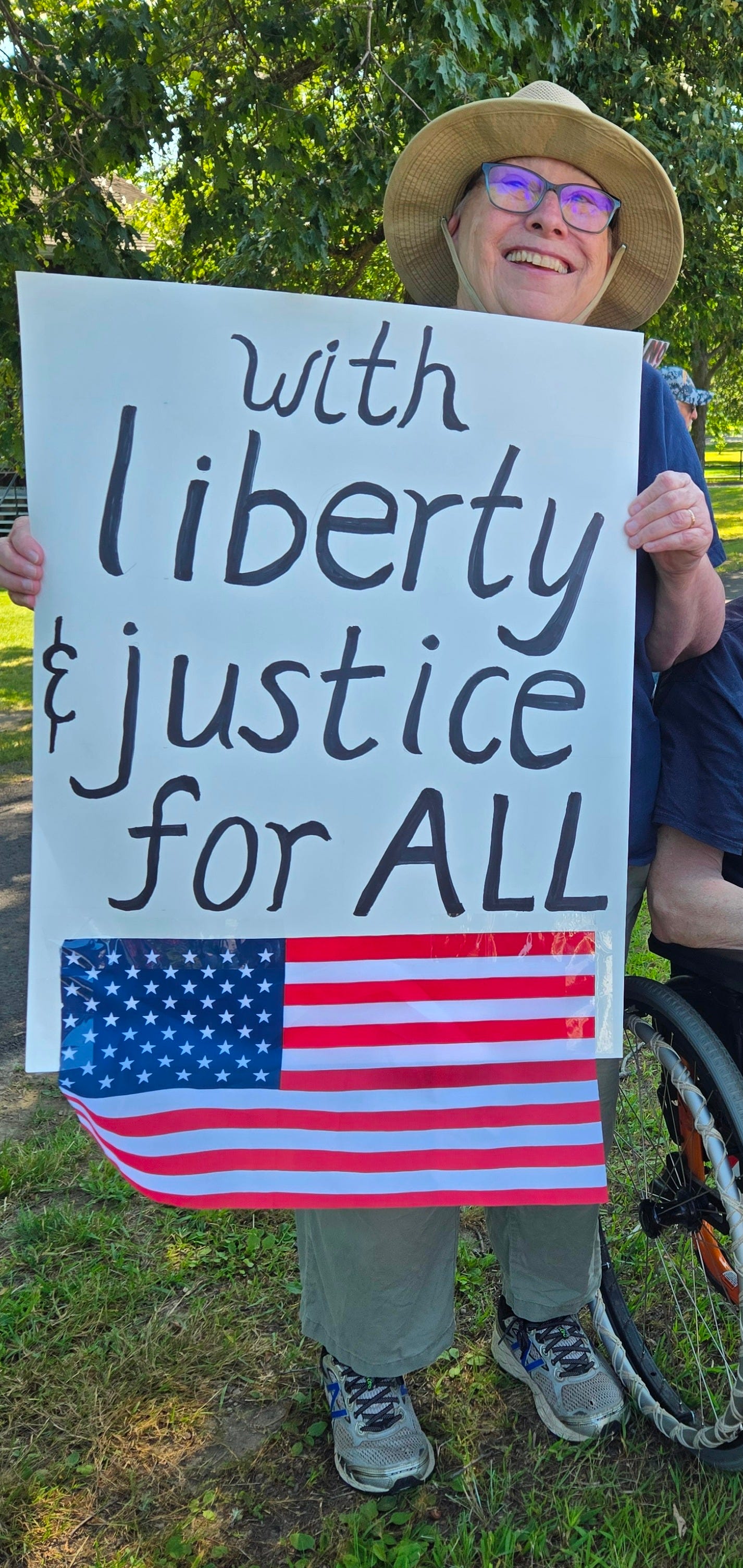
The idea is to live life in such a way that we pass along what is best about us. We do the work of healing, loving, caring, and nurturing “heedless of reward,” as Mary Gordon puts it. We do it for the simple reason that we have been given the privilege of life, and we best spend our energies giving back to the world that holds, sustains, and carries us. That’s our lineage — our lineage of work invisible, but so, so crucial. Because you never know what action or words of yours will take hold in another’s life. You just never know.
My line of mothers, now destined to die out, will never be known in any particular, lasting way. But I give thanks for all those mothers, whose work ultimately gave me life. And I give thanks for the opportunity to live and to give back as best I can.
When I think about it, women are uniquely experienced in producing work that is invisible — at least historically in this culture. Eric Peltoniemi’s song, Tree of Life, one of my favorites, depicts that invisibility in a poetic way. I hope you will take a few minutes to listen to it and consider the lineage of mothers who gave you life. Their work was undoubtedly invisible, but a thing of beauty nonetheless. (Note: The lyrics mostly consist of the names of quilting patterns. If you watch the video embedded below, you can see gorgeous images of those very patterns — the visible art of women whose contributions go unnamed and unrecognized. I’ve included the song lyrics below.)
Lyrics: Tree of Life, by Eric Peltoniemi
Beggar’s Blocks and Blind Man’s Fancy,
Boston Corners and Beacon Lights,
Broken Stars and Buckeye Blossoms
Blooming on the Tree of Life.
Chorus: Tree of Life, quilted by the lantern light,
Every stitch a leaf upon the Tree of Life.
Stitch away, sisters, stitch away.
Hattie’s Choice (Wheel of Fortune), and High Hosanna (Indiana),
Hills and Valleys (Sweet Wood Lilies)
and Heart’s Delight (Tail of Benjamin’s Kite),
Hummingbird (Hovering Gander) and Honeysuckle (Oleander),
Blooming on the Tree of Life.
We’re only known as someone’s mother,
Someone’s daughter, or someone’s wife,
But with our hands and with our vision,
We make the patterns on the Tree of Life.
Love,
Sylvia
My sister and I are also lines end. Not our choice, believe me. I knew, loved and appreciated your parents, wonderful people.
So lovely, Sylvia! Thank you.