
Captain Mowatt's Hot Sauce
Let Freedom Ring!


“Burning the planet one tongue at a time.” — Captain Mowatt’s Hot Sauce
(With thanks to Maryli Tiemann, who first told me about this history.)
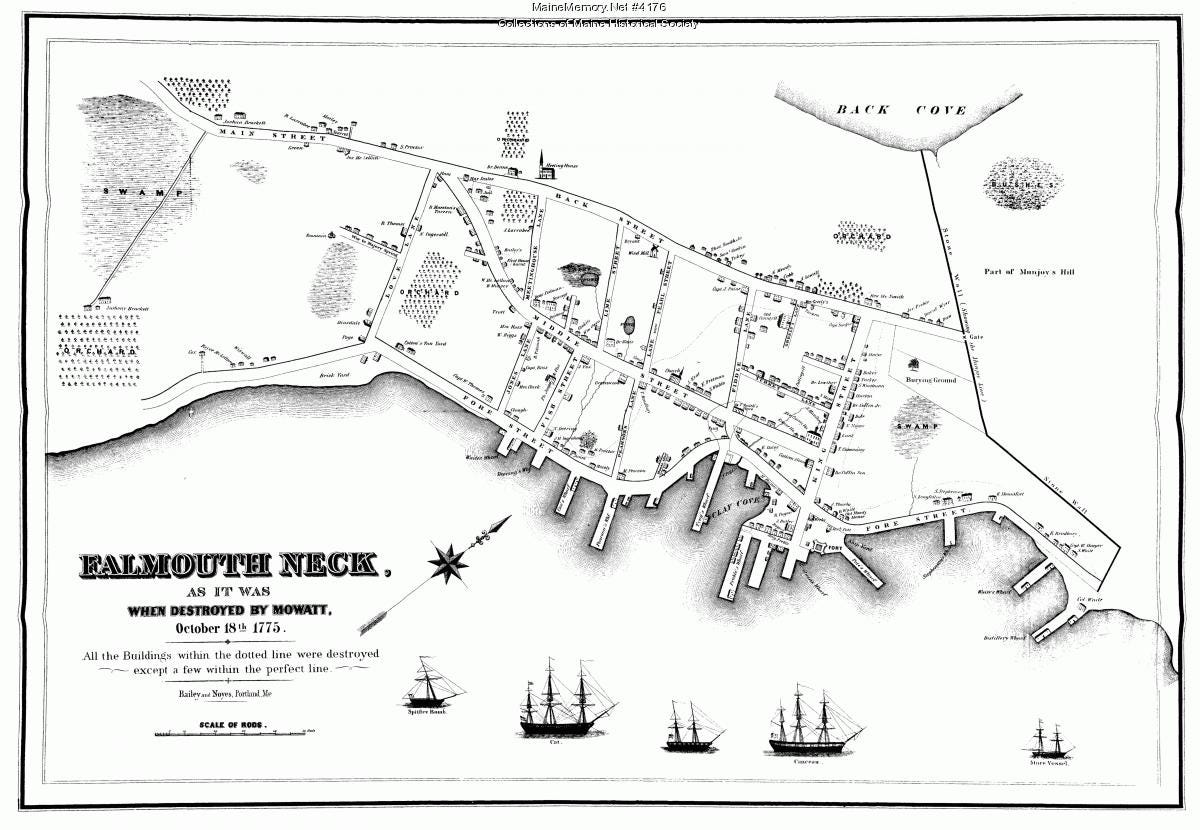
If you Google Captain Mowatt Portland Maine, you have to pass by a bunch of links to Captain Mowatt’s Hot Sauce before you reach information about the burning of Falmouth, Maine, on October 18, 1775. (In those days, the geographical area now known as Portland, Maine, was called Falmouth — or, more specifically, Falmouth Neck. The town of Falmouth still exists, now separate and north of the city of Portland.)
Captain Mowatt’s hot sauce is a real thing, even though you might be surprised to discover a company in the staid state of Maine producing hot sauces. Captain Mowatt’s even has a logo listed on their website: “Burning the Planet One Tongue at a Time.” Not only do the good people at Captain Mowatt’s have taste buds that range beyond fish chowder, blueberry pie, baked beans, red hot dogs, and whoopie pies, but they also have a twisted sense of humor that makes me chuckle.
But what you might not know is that Captain Mowatt was a real person, a British Navy Captain who was responsible for a pivotal moment during the Revolutionary War. Here’s the deal: Maine has a hot sauce named after the British captain who ordered his sailors to fire incendiary cannonballs from their ship into the city, following those up with a landing party that set fire to any buildings that had survived the initial blast. They burned down the entire city. That’s pretty fiery! Think about it next time you sprinkle some Captain Mowatt’s on your hot dog.
I actually started to write this post several months ago after I had the pleasure of taking a tour of Portland with a friend who is also a bona fide tour guide. “I’ll wait until October 18 before I publish,” I said to myself, “because that’s the anniversary of the actual event.” And not just any anniversary, but the 250th!
At the time, I didn’t realize October 18 was set aside for No Kings rallies all across the nation (and even the world — at least 19 other countries had rallies). And I didn’t realize Jane Goodall would be dying right around then. And I couldn’t have predicted those two things combined would inspire me to write my previous blog post, “Here on Planet Earth” (Here on Planet Earth - by Sylvia Stocker).
I also didn’t figure that the mighty Heather Cox Richardson — a Mainer like me — would also be watching the calendar, and she would beat me to the punch. As it turned out, HCR wrote up the history of the burning of Portland in the October 17 edition of her “Letters from an American” newsletter on Substack. She’s an actual historian, so I defer to her to recount the history of the event. HCR has a bazillon subscribers to her Substack blog, so probably a lot of you have already read what she wrote. But if you haven’t, and you want to know the history, I’ve pasted in HCR’s post below.
Let me tell the history in very basic strokes and then point to a couple of things HCR left out of her recounting. (For example, she left out the hot sauce.)
Following the Battles of Lexington and Concord, Maine militia men followed up by capturing British boats off the coast of Maine. That led to several successful skirmishes on the part of the Colonists, and it also inspired the high dudgeon of British King George and the British admiralty. As a result, the British fleet was ordered to attack towns up and down the coast, in hopes of subduing any rebellion. That’s how Captain Mowatt came to be in the Falmouth Neck harbor, threatening to set the town ablaze.
But here’s something to underscore. Captain Mowatt gave the townspeople warning of his intentions. At first, he gave just two hours’ notice — hardly enough time for the townspeople to gather up their families, livestock, and possessions. But some of the townspeople successfully lobbied for Captain Mowatt to give them the full night to evacuate. It’s hard for me to conceive of war being conducted in such a gentlemanly way (if that’s what you can call it), but that’s what happened. As a result, not one townsperson died. People spent the hours they had to collect all they could and leave before the incendiary cannon shells hit the town.
Now, the devastation was brutal, of course, especially coming, as it did, just before a legendary Maine winter was about to set in. But the preservation of human life (and doubtless animal life, too) is pretty striking, at least to me, when I stop to consider how differently Captain Mowatt might have acted.
And here’s something else to consider: The burning of Portland (Falmouth Neck) is actually mentioned in the Declaration of Independence, in the looooong list of grievances the colonies held against King George. (If you have never read the full Declaration of Independence, I recommend you do so. You will note many ironies, especially given today’s political climate in America: Declaration of Independence: A Transcription | National Archives.) This is one of those many accusations the Colonists made against King George: “He has plundered our seas, ravaged our Coasts, burnt our towns, and destroyed the lives of our people.” That grievance points directly to the burning of Portland.
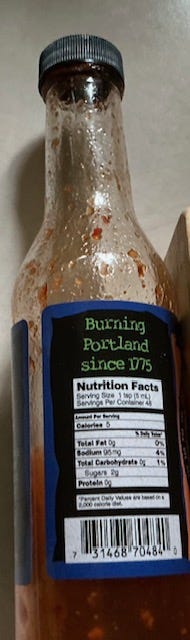
And then there’s the hot sauce. I confess I’ve never tried it, but I love that it exists. There’s humor there, and there’s also this: If you mess with people’s freedom, if you push people too far, you are bound to deepen any rebellion; you are bound to inspire the longing for freedom to rise up from the human heart. And, in the end, you might be remembered in a bit of humor on a jar of hot sauce, rather than as the mighty Captain you once thought you were destined to be.
I love you. Read Heather’s words below. And — whether it’s Captain Mowatt’s hot sauce or something else — I hope you will take a moment to indulge in some culinary delight that will remind you of the American Revolution. Let freedom ring!
Love,
Sylvia
HCR’s Blog Post
(Here is Heather Cox Richardson’s October 17 post. If you don’t already subscribe to her Substack blog, I highly recommend it. When you subscribe, Substack gives you the option of paying for the blog, but Heather Cox Richardson actually encourages people to subscribe for free.)
On the morning of October 18, 1775, a small fleet of Royal Navy vessels opened fire on the seaport town that is now known as Portland, Maine. Under the direction of Captain Henry Mowat, the ships fired incendiary shot into the trading port’s wooden buildings, which caught fire. A landing party followed to complete the destruction of 400 buildings in the town. By the time the sun went down, almost all of the town was smouldering ruins.
The burning of the town then known as Falmouth, Massachusetts—not the same town as today’s Falmouth, Maine, or Falmouth, Massachusetts, on Cape Cod—was retaliation for raids local mariners had made against British ships along the coast of New England. Since 1765, with the arrival of news of the Stamp Act to raise revenue to pay for the French and Indian War, residents of Falmouth had joined other colonists in protesting British policies.
In spring 1775, the colonies agreed to boycott British goods in order to pressure Parliament into addressing their grievances. In March a shipload of sails, rope, and rigging arrived in Falmouth for a loyalist shipbuilder. Patriots demanded the ship carrying the supplies leave port, but they agreed to let it undergo repairs before heading back across the Atlantic Ocean. While shipbuilders worked on the vessel, the British man-of-war Canceaux arrived from Boston under the command of Captain Henry Mowat. Under the Canceaux’s protection, the loyalist unloaded the ship’s cargo.
While the Canceaux lay at anchor, news arrived of the Battles of Lexington and Concord, where British regulars had opened fire on the colony’s militiamen. When they heard of the battles, militia from Brunswick, about 25 miles 40 kilometers) north of Falmouth, decided to capture the Canceaux. Led by tavern owner Samuel Thompson, they traveled to Falmouth in small boats in May and captured Mowat while he was on shore. The sailors on the Canceaux threatened to shell the town if the militia didn’t release Mowat. Eventually, the militiamen released him but refused to turn Thompson over for punishment, and locals forced the Canceaux to leave the harbor.
In June, when news of the Brunswick militia’s escapade reached militiamen in Machias, near the Canadian border, they decided to capture the Margaretta, a British armed schooner that was protecting two merchant ships carrying supplies to the troops hunkered down in Boston after the Battles of Lexington and Concord.
Heartened by these successes, during the summer of 1775, American privateers raided British ships. Coming after the Battles of Lexington and Concord, their harassment helped to convince the king’s Cabinet that they must use military and naval force to put down the rebellion in the colonies.
On October 6, 1775, Vice-Admiral Samuel Graves, who commanded the British North Atlantic fleet, decided he would regain control of the coastal townspeople by terrorizing them. He ordered Captain Mowat to retaliate against the colonists, directing him to take four ships and “lay waste burn and destroy such Seaport Towns as are accessible to his Majesty’s Ships.” “My Design is to chastize Marblehead, Salem, Newbury Port, Cape Anne Harbour, Portsmouth, Ipswich, Saco, Falmouth in Casco Bay, and particularly Mechias where the Margueritta was taken,” Graves wrote. “You are to go to all or to as many of the above named Places as you can, and make the most vigorous Efforts to burn the Towns, and destroy the Shipping in the Harbours.”
Mowat decided against attacking the towns near Boston, recognizing that they were close enough together to mount a spirited defense. Instead, he headed for Falmouth, dropping anchor there on October 16. The next day, Mowat accused the townspeople of “the most unpardonable Rebellion” and informed them that he had “orders to execute a just Punishment on the Town of Falmouth.” He warned them “to remove without delay the Human Species out of the said town” and gave them two hours to clear out.
The townspeople were shocked. An eyewitness recalled that a committee of three men asked Mowat what was going on, and he answered “that his Orders were to set fire on all the Sea Port Towns between Boston and Halifax & that he expected New York was then Burnt to Ashes.” The committee negotiated to put off the attack for the night, but they would not agree to Mowat’s promise to spare the town if they would relinquish all their weapons and hand over “Four Gentlemen of the Town as Hostages.”
Throughout the night, the townspeople hurried to save their possessions and move out of danger.
The next morning was clear and calm, and at 940 the Canceaux and the other ships opened fire. “In a few minutes the whole town was involved in smoak [sic] and combustion,” an eyewitness recalled. “The crackling of the flames, the falling of the houses, the bursting of the shells, the heavy thunder of the cannon, threw the elements into frightful noise and commotion, and occasioned the very foundations of surrounding nature to quake and tremble.” When a lack of wind kept the fires contained, Mowat sent sailors ashore to spread them.
Although Admiral Graves was pleased with Mowat’s assault on Falmouth, the attack backfired spectacularly.
Rather than terrorizing the colonists into submission, the burning of Falmouth steeled their resolve. From his position at the head of the brand new Continental Army in Cambridge, Massachusetts, George Washington wrote to revolutionary leader John Hancock that the burning of Falmouth was “an Outrage exceeding in Barbarity & Cruelty every hostile Act practised among civilized Nations.”
Washington noted that Mowat had warned that he would make similar attacks on port towns all along the coastline, prompting the Continental Congress on November 25 to authorize American ships to capture British armed vessels, transports, and supply ships. Meanwhile, the people in the coastal towns fortified their defenses and prepared to fire back at any attacking British ships.
Colonists saw the burning of Falmouth as proof that their government had turned against them, and began to suggest they must declare independence. About a month after Falmouth burned, William Whipple, a prominent resident of Portsmouth, New Hampshire, wrote to a friend that the destruction and threat to visit such ruin on other towns caused “everyone to risque his all in Support of his Liberties & privileges…the unheard of cruelties of the enemy have so effectually unified us that I believe there are not four persons now in Portsmouth who do not [oppose] the Tyranny of Great Britain.”
— Notes:
Donald A. Yerxa, “The Burning of Falmouth, 1775: A Case Study in British Imperial Pacification,” Maine History 14, 3 (1975): 119–161, available at: https://digitalcommons.library.umaine.edu/cgi/viewcontent.cgi?article=1758&context=mainehistoryjournal
https://navydocs.org/node/13003
https://www.mainememory.net/sitebuilder/site/899/page/1310/display?page=2
https://www.mainememory.net/record/6777
https://founders.archives.gov/documents/Washington/03-02-02-0210-0002
Letter of the Reverend Jacob Bailey on the Burning of Falmouth, in Collections of the Maine Historical Society, volume 5, (Portland, 1857), pp. 447–448, available at: https://www.google.com/books/edition/Collections_of_the_Maine_Historical_Soci/UgY8AAAAIAAJ
https://founders.archives.gov/documents/Washington/03-02-02-0210-0001
So well timed, Sylvia! And how almost polite to give the people notice and time to get away from Falmouth Neck, even though it was war.
I wanted to add a note about Captain Mowatt’s hot sauce. For many years I worked part time at Lisa Marie’s made in Maine gift shop in Bath. They have a whole range of the Captain’s hot sauces. Lisa Marie’s husband Andy LOVES hot sauce! He tried them all and arranged them in numerical order by heat. I think there may be 19 sauces there, in case anyone wants to try some.😁 🔥 Irene
You know I LOVE THIS. And how timely, how thoughtful, how right.
Mowatt’s Hot Sauce isn’t too hot.