
Because of You

“Now it is your turn to let freedom ring. When historians pick up their pens to write the story of the 21st century, let them say that it was your generation who laid down the heavy burdens of hate at last and that peace finally triumphed over violence, aggression and war. So I say to you, walk with the wind, brothers and sisters, and let the spirit of peace and the power of everlasting love be your guide." — John Lewis
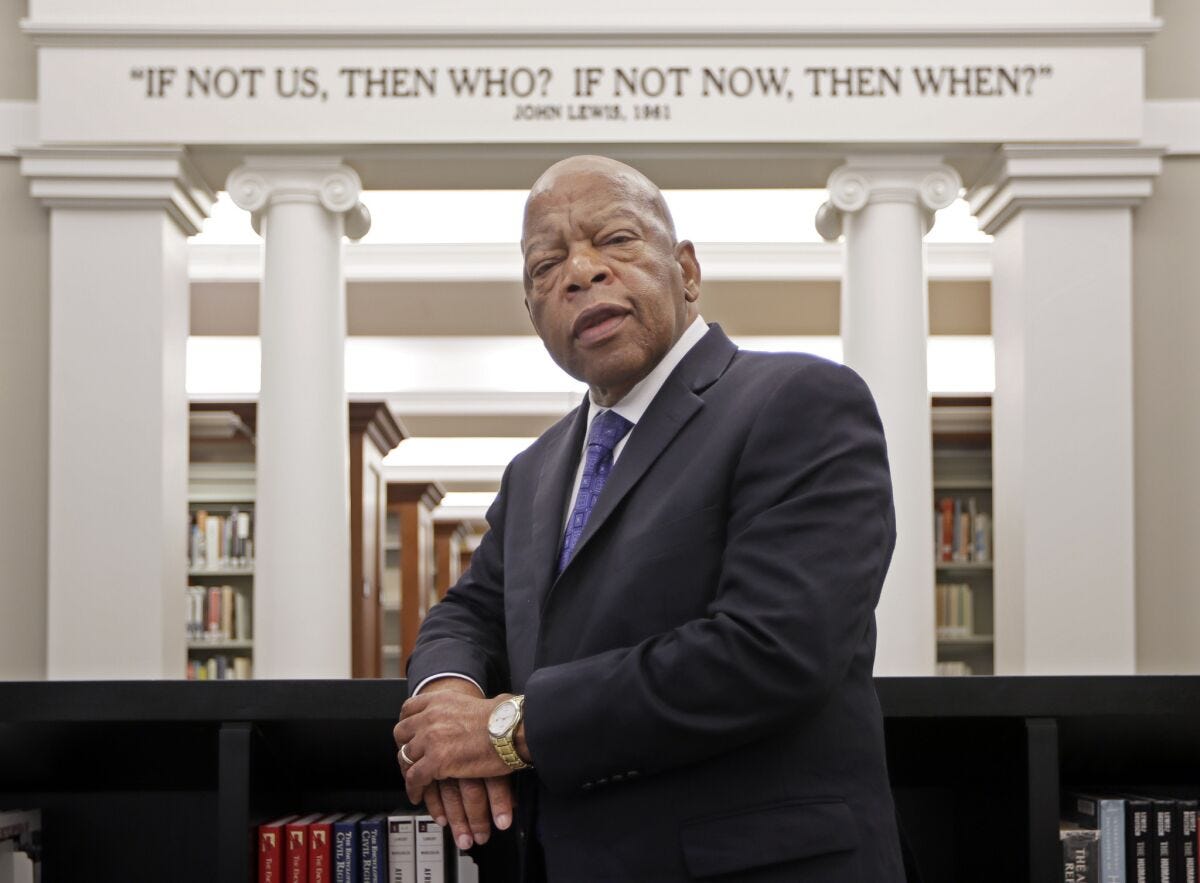
If you have been reading this blog for any length of time, you already know John Lewis is one of my heroes. He died 5 years ago, on July 17. The anniversary is approaching, so I want to remember and honor him today.
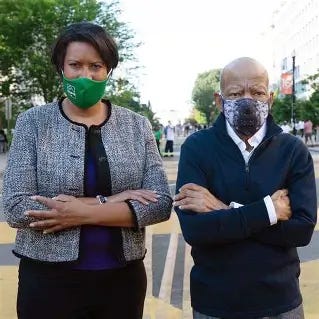
The comparison between my life and John Lewis’s is pretty stark. I have had a relatively sheltered life; he had anything but. I grew up in the north, in the middle class, with all the privileges of being White. John Lewis grew up in a poor family in Alabama, in the Jim Crow south, enduring the prejudice, racism, oppression, and injustice aimed at Black people. My father had a managerial desk job in Boston and my mother stayed home with the children. Both of Lewis’s parents were crop pickers — cotton, peanuts, corn — and, during harvest times, the children joined them in the fields. My family lived in a ranch house with all the amenities. Lewis’s family lived in a house with no electricity or running water. I remember accompanying my mother to the voting booth and watching her fill out her ballot on Election Day. John Lewis’s parents were not afforded the right to vote, so Lewis had no opportunity to have that example set for him.
As I say, a stark comparison.
At an early age, Lewis heard an inspiring preacher by the name of Martin Luther King, Jr., on the family radio. Lewis became a young convert to and proponent of King’s message of nonviolent protest. As such, Lewis co-founded the Student Non-Violent Coordinating Committee (SNCC), and he helped to organize and lead many actions during the Civil Rights movement: the Freedom Rides, the marches from Selma to Montgomery, the 1963 March on Washington. Nowadays memories of those early days seem dominated by John Lewis facing down armed troops and attack dogs on the Edmund Pettus Bridge in Selma on “Bloody Sunday” in 1965 — and being attacked, beaten, with a fractured skull as a result. But Lewis, in fact, was one of the speakers at the 1963 March on Washington. Yes, he shared the same podium where the Rev. Dr. King stood when he delivered his famous “I Have a Dream” speech.
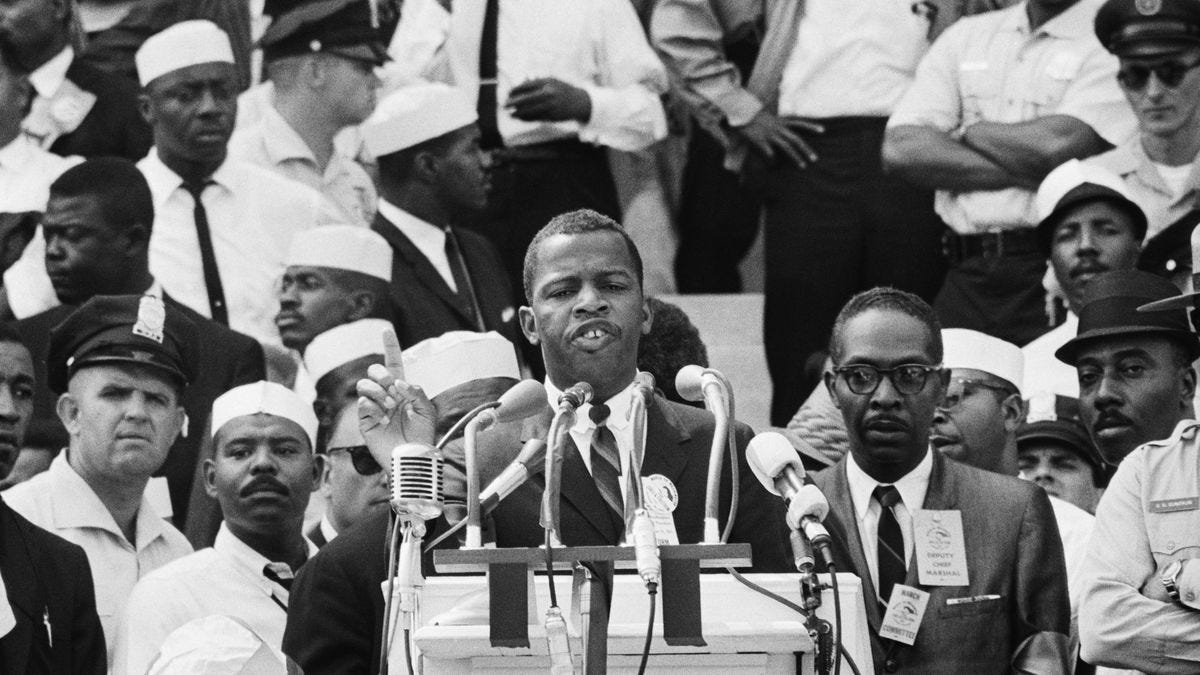
Lewis was elected to the U. S. House of Representatives in 1986, serving Georgia’s 5th District until his death in 2020. John Lewis devoted his life to this country. His contributions to the Civil Rights movement were manifold, and he remained committed to that work until the day he died.
There is a story from President Barack Obama’s first inauguration, best told by the New Yorker’s David Remmick:
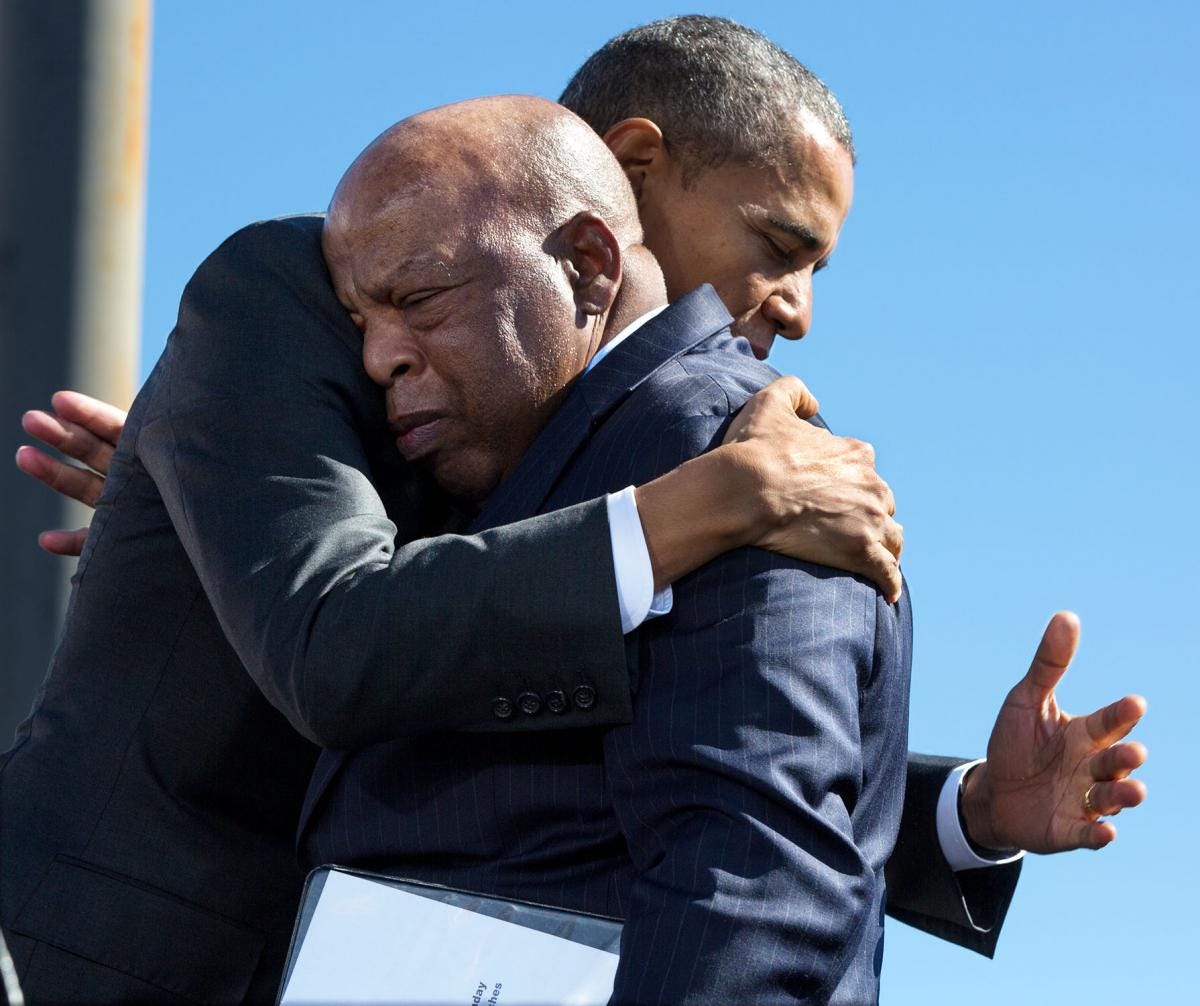
“.. . . After absorbing the thudding roar from the Mall, Obama glanced to his right. He spotted there on the steps, a few feet away, John Lewis –– squat, bald, hatless –– the eleven-term representative of Georgia’s fifth congressional district and the only one of the speakers at the March on Washington still among the living. Obama bent to embrace him.
“‘Congratulations, Mr. President,’ Lewis whispered in his ear.
“Obama smiled at the sound of that and said, ‘Thank you, John. I’ll need your prayers.’
“‘You’ll have them, Mr. President. That, and all my support. . .’
“. . . At the luncheon following the swearing-in ceremony, Lewis approached Obama with a commemorative photograph and asked him to sign it. The President wrote, ‘Because of you, John. Barack Obama.’”
When I consider the trajectory of Lewis’s life and the depth of his contributions to America, I am awestruck. I simply want to bow down with gratitude. John Lewis epitomizes the edict to never give up. I am an example of the Biblical precept that ‘to whom much is given much is required.’ (Luke 12:48, paraphrased.)
When, on July 17, several national organizations, such as Indivisible and 50501, are calling for nationwide rallies in Lewis’s memory, I hope to be there. Dubbed the “Good Trouble” rallies, they harken back to John Lewis’s posthumous letter to America in which he said, “Ordinary people with extraordinary vision can redeem the soul of America by getting in what I call good trouble, necessary trouble.” The letter is worth reading in its entirety, so I offer it here, in tribute to a man I so admire (from the New York Times, July 30, 2020):
"While my time here has now come to an end, I want you to know that in the last days and hours of my life you inspired me. You filled me with hope about the next chapter of the great American story when you used your power to make a difference in our society. Millions of people motivated simply by human compassion laid down the burdens of division.
“Around the country and the world you set aside race, class, age, language and nationality to demand respect for human dignity. That is why I had to visit Black Lives Matter Plaza in Washington, though I was admitted to the hospital the following day.
“I just had to see and feel it for myself that, after many years of silent witness, the truth is still marching on. Emmett Till was my George Floyd. He was my Rayshard Brooks, Sandra Bland, and Breonna Taylor. He was 14 when he was killed, and I was only 15 years old at the time.
“I will never ever forget the moment when it became so clear that he could easily have been me. In those days, fear constrained us like an imaginary prison, and troubling thoughts of potential brutality committed for no understandable reason were the bars.
“Though I was surrounded by two loving parents, plenty of brothers, sisters and cousins, their love could not protect me from the unholy oppression waiting just outside that family circle. Unchecked, unrestrained violence and government sanctioned terror had the power to turn a simple stroll to the store for some Skittles or an innocent morning jog down a lonesome country road into a nightmare.
“If we are to survive as one unified nation, we must discover what so readily takes root in our hearts that could rob Mother Emanuel Church in South Carolina of her brightest and best, shoot unwitting concertgoers in Las Vegas and choke to death the hopes and dreams of a gifted violinist like Elijah McClain.
“Like so many young people today, I was searching for a way out, or some might say a way in, and then I heard the voice of Dr. Martin Luther King Jr. on an old radio. He was talking about the philosophy and discipline of nonviolence. He said we are all complicit when we tolerate injustice.
“He said it is not enough to say it will get better by and by. He said each of us has a moral obligation to stand up, speak up and speak out. When you see something that is not right, you must say something. You must do something. Democracy is not a state. It is an act, and each generation must do its part to help build what we called the Beloved Community, a nation and world society at peace with itself. Ordinary people with extraordinary vision can redeem the soul of America by getting in what I call good trouble, necessary trouble.
“Voting and participating in the democratic process are key. The vote is the most powerful nonviolent change agent you have in a democratic society. You must use it because it is not guaranteed. You can lose it. You must also study and learn the lessons of history because humanity has been involved in this soul-wrenching, existential struggle for a very long time.
“People on every continent have stood in your shoes, through decades and centuries before you. The truth does not change, and that is why the answers worked out long ago can help you find solutions to the challenges of our time. Continue to build union between movements stretching across the globe because we must put away our willingness to profit from the exploitation of others.
“Though I may not be here with you, I urge you to answer the highest calling of your heart and stand up for what you truly believe. In my life I have done all I can to demonstrate that the way of peace, the way of love and nonviolence is the more excellent way.
“Now it is your turn to let freedom ring. When historians pick up their pens to write the story of the 21st century, let them say that it was your generation who laid down the heavy burdens of hate at last and that peace finally triumphed over violence, aggression and war. So I say to you, walk with the wind, brothers and sisters, and let the spirit of peace and the power of everlasting love be your guide."
I feel hopeful and inspired because of you, John Lewis. Because of you.
With gratitude, love,
Sylvia
Sources:
The President’s Hero | The New Yorker
John Lewis (February 21, 1940 - July 17, 2020) | National Archives
Opinion | John Lewis: Together, You Can Redeem the Soul of Our Nation - The New York Times
Just got to share this one. The moments between JL and Obama are particularly touching. Can’t imagine the energy of their bond.
Yes, a hero indeed. Thanks, Sylvia, for reminding me of his “good troubles” lifelong commitment.